
The return of "retarded" and Eric Fromm's 'un foíle á millíons'

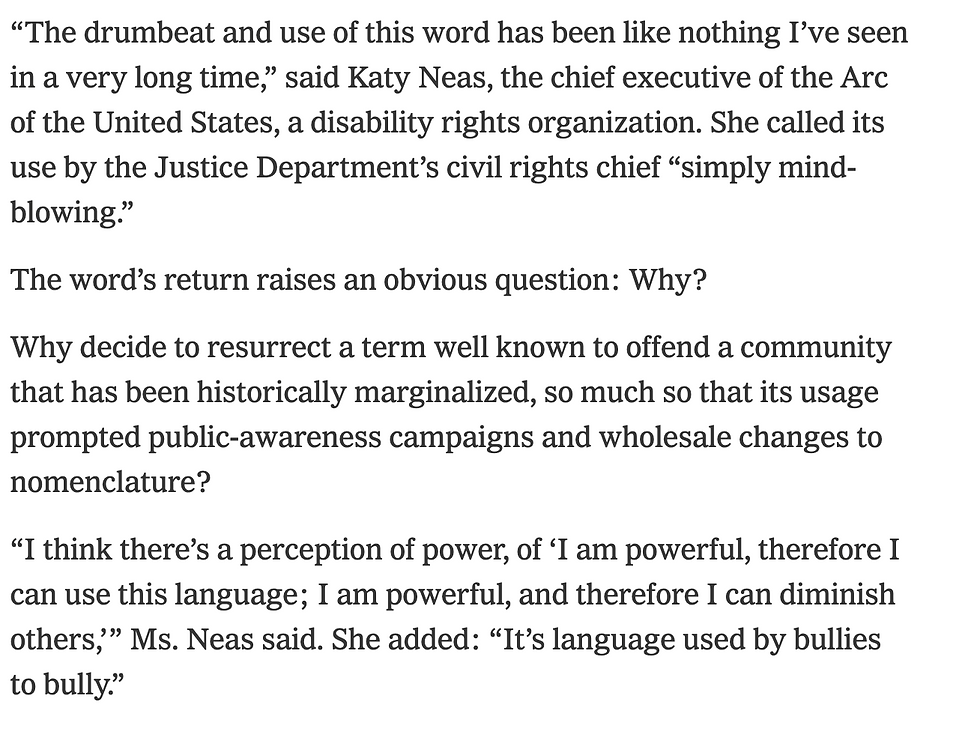
The Times article below makes plain what many in the disability community have long understood in their bones: the slow violence of attrition, the quiet undoing that comes not with a single blow but with a thousand small, carefully administered cuts. For those who depend on the moral seriousness of public institutions, this kind of erosion is not abstract. It is lived, daily, as fear, exhaustion, and vigilance.
We appear to be living through a moment of profound social unmaking. A significant minority—perhaps a quarter of the population—has surrendered itself to what Erich Fromm, in The Sane Society, described as la folie à millions: a madness shared, normalized, and therefore protected from scrutiny. It is not merely a difference of opinion. It is a deformation of moral perception. Having attached themselves to a figure who embodies a malignant narcissism, many have absorbed its habits of mind. They come to see the world as a zero-sum contest of comforts, where the needs of others appear not as claims upon our common humanity, but as threats.
In this way, sociopathy becomes banal. One learns to believe whatever is convenient, because belief itself is no longer tethered to responsibility. Freedom is redefined as the absence of obligation—to truth, to neighbor, to the vulnerable.
The pattern is familiar. Representative Jeff Van Drew promised never to vote for cuts to Medicaid and then did precisely that. Soon after, he found it acceptable to attribute a mass shooting to “sanctuary” policies, invoking the familiar trope of dangerous outsiders roaming freely. The ease with which such claims are made—without evidence, without shame—reveals not only dishonesty, but a willingness to instrumentalize fear. This, too, is part of the thousand cuts.
History teaches us that such strategies are rarely improvised. Fromm’s analysis of Nazi Germany reminds us that societies test their methods of exclusion first on those least able to resist: immigrants, the poor, the disabled. If the public tolerates this, the circle widens.
The logic is always the same: some people are too costly, too needy, too inconvenient to be fully human.
What makes this moment especially dangerous is its diffusion. It is no longer confined to bureaucratic cultures or policy language. It is in the air. It seeps into daily life.
Recently, while running errands, I encountered a man wearing a shirt designed to assault everyone around him. The language was crude, dehumanizing, explicitly violent in implication. He wore it proudly, deliberately, as if conscripting strangers into his worldview. I watched the faces around me—people frozen in that familiar silence, unsure whether they were alone in their revulsion.
I was not silent. I named what I saw. I called it what it was. Others joined in. And as always happens, the man fled. Bullies depend on the illusion of consensus. When that illusion shatters, they collapse.
I do not imagine these moments as heroic. But they matter. They remind bystanders that they are not isolated. They offer a kind of moral permission—to speak, to refuse, to stand upright. And even for the person embodying the hate, they offer something rare: an interruption. A crack in the madness of millions. A chance, however small, to step back into reality.
We are not meant to live under the weight of this level of collective derangement. Silence is not a requirement. Fear is not a duty. Each of us can act in ways suited to our temperaments and circumstances. We can speak plainly. We can educate those around us. We can make visible the connection between everyday cruelty and systemic harm.
Naming a thing does not always change it—but refusing to name it guarantees that it will spread. If you have found a way to resist, share it. If you have not, borrow one. Circulate the article. Tell your story. Let others know that their fear and sleeplessness are not private failures, but reasonable responses to a public crisis.
History does not only judge what was done. It judges what was tolerated.








Comments